• Thanks for visiting the Kaleidescape Owners' Forum

    This forum is for the community of Kaleidescape owners, and others interested in learning about the system, equipment, services, and the company itself.

    It is run by a group of enthusiastic Kaleidescape owners and dealers purely as a service to this community.

    This board is not affiliated in any way with Kaleidescape, Inc.
    For official technical support, product information, or customer service, please visit www.kaleidescape.com

    You can dismiss this box forever by clicking the "X" in the upper right corner of this message.
  • You are currently in "Guest" mode and not logged in with a registered account.

    The forum is free to use and most of the forum can be used by guests who are not registered....

    ... but we strongly encourage you to register for a full account. There is no cost to register for a full account.

    Benefits of registering for a full account:

    • Participate in the discussions! You must have a registered account to make posts on the forums. You will be able to start your own thread on a topic or question, or you can reply to other threads/discussions.
    • Use the "Conversation" feature (known as "private messaging" on other forums) to communicate directly with any of the other users here.
    • Access the Files area. The "resources" area of the forum contains many "Favorite Scene" and Script files that can dramatically increase the enjoyment of your Kaleidescape system. Go directly to great scenes in your favorite movies, created by other owners, and add automation to playback of your system with Scripts.
    • You won't see this annoying notice at the top of every screen!😊

    It's easy and free to register for the forum. Just click the "Register" button in the upper right corner of this page, and follow the instructions there.

    This box goes away for registered users.

Mike Cobb on the radio...

WALLHALLA

Well-known member
⭐️ Premium ⭐️
Joined
Jan 14, 2007
Messages
864
Location
Miami, Puerto Rico and the USA..
 
“Summary

As home entertainment systems become more sophisticated, delivering a truly immersive experience requires more than a large display and powerful speakers. It requires careful consideration of every component, from the content source to the screen and audio system.

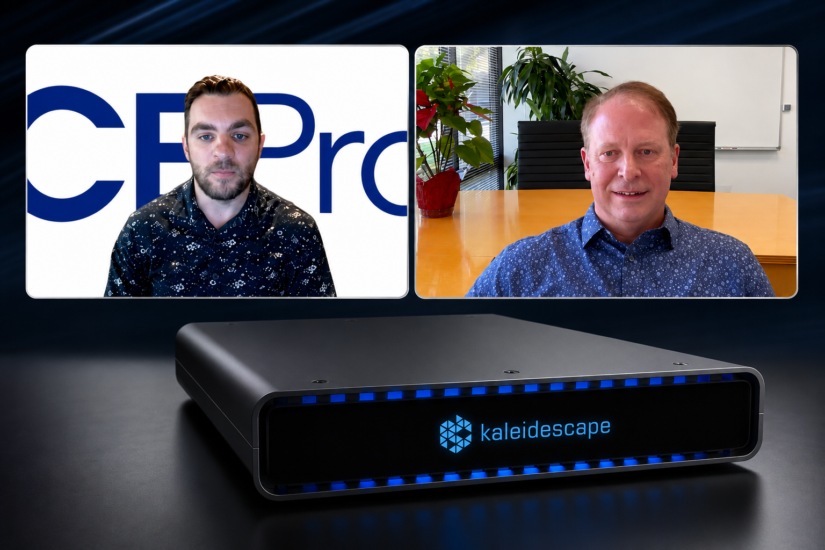
That was the focus of a CEDIA Expo 2026 Smart Stage discussion moderated by CE Pro Executive Editor Zachary Comeau, featuring Michael Kobb of Kaleidescape, Rob Budde of JVC, Phil Holland of PHFX and Juan Reyes of the 8K Association.

The panel explored how advances in display technology, higher resolutions, HDR and immersive audio are changing consumer expectations and creating new opportunities for integrators.

With screens exceeding 100 inches becoming increasingly common, panelists emphasized the importance of selecting the right display for the room. Holland discussed how viewing distance and field of view influence immersion, while Budde stressed the importance of matching projection screens with the capabilities of the projector.

The discussion also addressed the role of content quality in maximizing system performance. Kobb explained how Kaleidescape’s Strato K player and new 4K Cinematic format deliver improved color fidelity, detail and motion performance, even on existing 4K systems.

Panelists also examined the industry’s transition toward 8K, including the growing availability of 8K masters, the importance of interoperability standards and the challenges of bringing higher-resolution content into homes.

For integrators, the central takeaway was that immersive entertainment depends on the entire system working together. While display size, resolution and audio performance remain critical, the quality of the source material and thoughtful system design ultimately determine how closely the experience reflects the filmmaker’s original vision.”
Mike Kobb is still probably talking about the only 8K movies that are likely in the pipeline are older films, which is ok by mean. I mean I'm not in the market but its exciting non-the-less for K player owners.
 
Well, my crystal ball—the same one that suggested offering larger mezzanine files in this forum two years ago—says that in a few years, Kaleidescape will have to look into AI 2D-to-3D conversion of its mezzanine files. The technology is here today, and it is eagle-eyed-videophile perfect.

If 3D was once the poster boy for viewing discomfort because of its limited Z-axis, the dramatically expanded depth now possible changes the equation. The image can create the impression that you are seeing around foreground figures—almost as if you could glimpse behind someone’s head as you move from left to right. With dual-eye, dual-depth conversion and precise viewing-angle data—in other words, screen width and viewing distance—entered into the algorithms, the opposite is true: you crave putting on the glasses for comfort that surpasses 2D. You heard it here first.

Anyone visiting South Florida is welcome to experience the next $100 million home-cinema revolution in the form of the one in the world Sunmi -451 unabridged movie.

Cloud Atlas contains what may be one of the greatest science-fiction stories ever buried inside another movie.

The problem is that this 31-and-a-half-minute story was chopped into 31 separate segments. Some run for several minutes. Others last only a few seconds. They were then scattered confetti-style among six other stories.

Whatever the editorial theory behind that decision, the science-fiction story becomes considerably more compelling when it is allowed to exist continuously.

So all 31 pieces have been reconstructed into a single uninterrupted 31-and-a-half-minute movie.

This is one of those rare occasions when strict obedience to the director’s intention has been politely declined.

Or, less politely:

The CREator who is a CREtine is given the middle finger.

Sometimes artistic intent deserves protection. Sometimes the material itself demonstrates that the decision got in the way of the experience. In this case, the story gets fixed.

Cloud Atlas also brings a major technical advantage. The source image is dramatically better: modern cinematography, higher photographic detail, stronger color information, better fine texture, more specular information, complex reflections, transparent surfaces, deep architectural vistas, human subjects at multiple distances, and extreme perspective. All of those characteristics make Neo Seoul extraordinary material for evaluating the next generation of spatial presentation.

The early sequence alone demonstrates the range: rows of genetically engineered attendants resting in vertical pods; highly reflective blue floors with fish appearing beneath the surface; human figures crossing those reflections; intensely saturated food displays; surreal commercial environments; glossy materials; fine structural detail; and finally, the city itself.

Tiny human figures suspended on a narrow bridge above an urban canyon provide precisely the scale reference needed for the visual system to understand the enormous depth of the environment.

That combination is unusually demanding. It is also unusually revealing.

For once, Neo Seoul is allowed to remain Neo Seoul. No interruption after thirty seconds. No abrupt jump to another century. No change of cast. No interruption of the visual language. The environment has time to establish itself.

For anyone familiar with The Fifth Element, Blade Runner or Ghost in the Shell, the attraction should require very little explanation.
 
Last edited:
Also linked on the same website is the Tayloe’s interview from July. It is interesting to hear that Kscspe doubled their users post the introduction of Strato V player and TV users now account for about 50%.

Strato K probably helped user growth further.

 
Back
Top